
Model Context Protocol (MCP) Support
Transform any API or application into agent-ready tools
Skip building agent-specific code by turning your existing systems into MCP-compatible assets.
Skip building agent-specific code by turning your existing systems into MCP-compatible assets.
With MCP support, you expose your business logic, data and workflows to AI agents so they can act, not just observe.
Turn any API, integration or system into an action the agent can invoke — no custom code required.
Connect agent-driven actions to your backend systems and processes for true operational impact.
Leverage pre-built connectors, standardized protocols and a unified platform so your enterprise moves from pilot to production quickly.

Maximize the value of your enterprise APIs, workflows and logic by exposing them via the MCP protocol. Make internal tools, ERP systems, databases, SaaS apps and more accessible to AI agents through a consistent, secure interface.

Start building your AI impact with across some of the most popular business processes. Stand up Inventory-management agents with full context, customer-support agents with personalization. No matter your use case, ensure scalable, secure agent automation across your IT infrastructure.

MCP introduces a standard way for agents to interact with enterprise systems. Rather than building custom connectors for every agent framework, expose business capabilities in an agent-ready format via Agent Fabric.
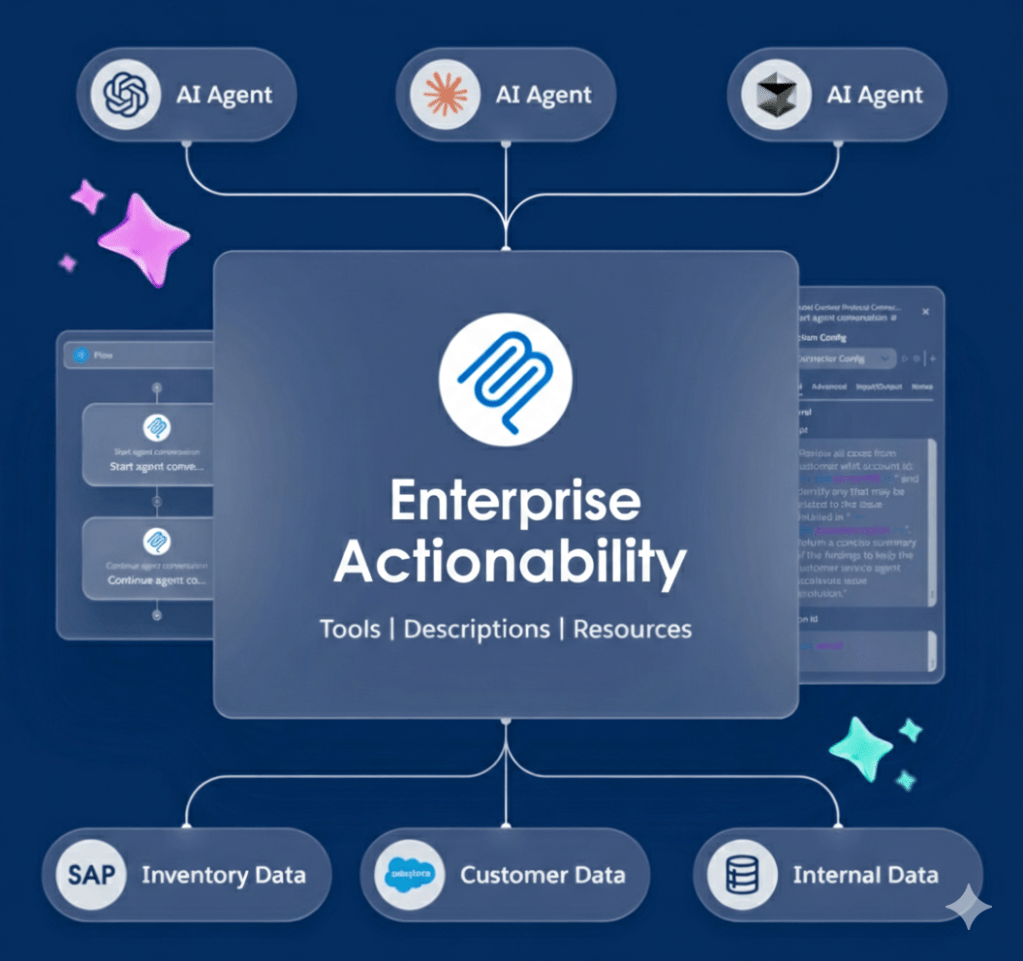
Activate existing APIs for agentic workflows without rewrites or new runtimes. MCP Bridge exposes trusted systems as MCP tools via Omni Gateway (formerly Flex Gateway), so agents operate under existing security and governance. Enable internal or customer automation with consistent, observable, scalable access.
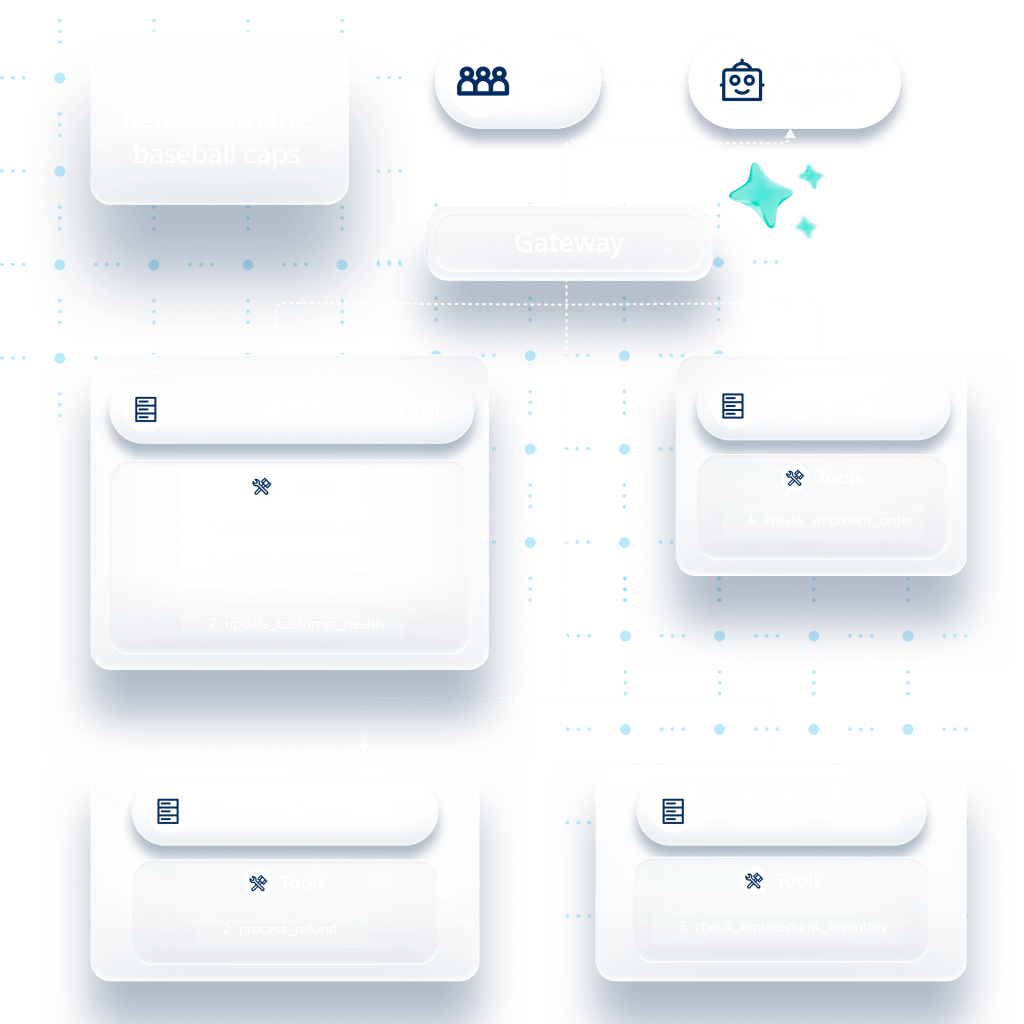
While the Model Context Protocol (MCP) provides the open standard for agent-to-tool communication, the real challenge for the enterprise is implementation without creating technical debt or security gaps.
Agent Fabric applies the proven principles of API-led connectivity to the agentic era, allowing you to treat MCP as a governed interfacing layer that bridges the gap between your stable systems of record and the latest AI models.
Moving from AI experimentation to production requires more than a technical protocol; it requires an insurance policy for the future. Without an enterprise MCP strategy, organizations face security risks, redundant point-to-point integrations, and a lack of operational visibility. Based on Agent Fabric's strategy for agentic AI, a successful implementation rests on four critical pillars:
Manage and govern all MCP servers on a single control plane with defined ownership, lifecycle and access management.
Route MCP traffic through existing gateway infrastructure to enforce authentication, rate limiting, and threat detection centrally.
Deploy and scale quickly with production-ready monitoring, tracing, alerting, SLAs, and audit logging all within one platform.
Use a single, centralized registry to make tools discoverable and reusable across the organization, preventing silos and redundant code.
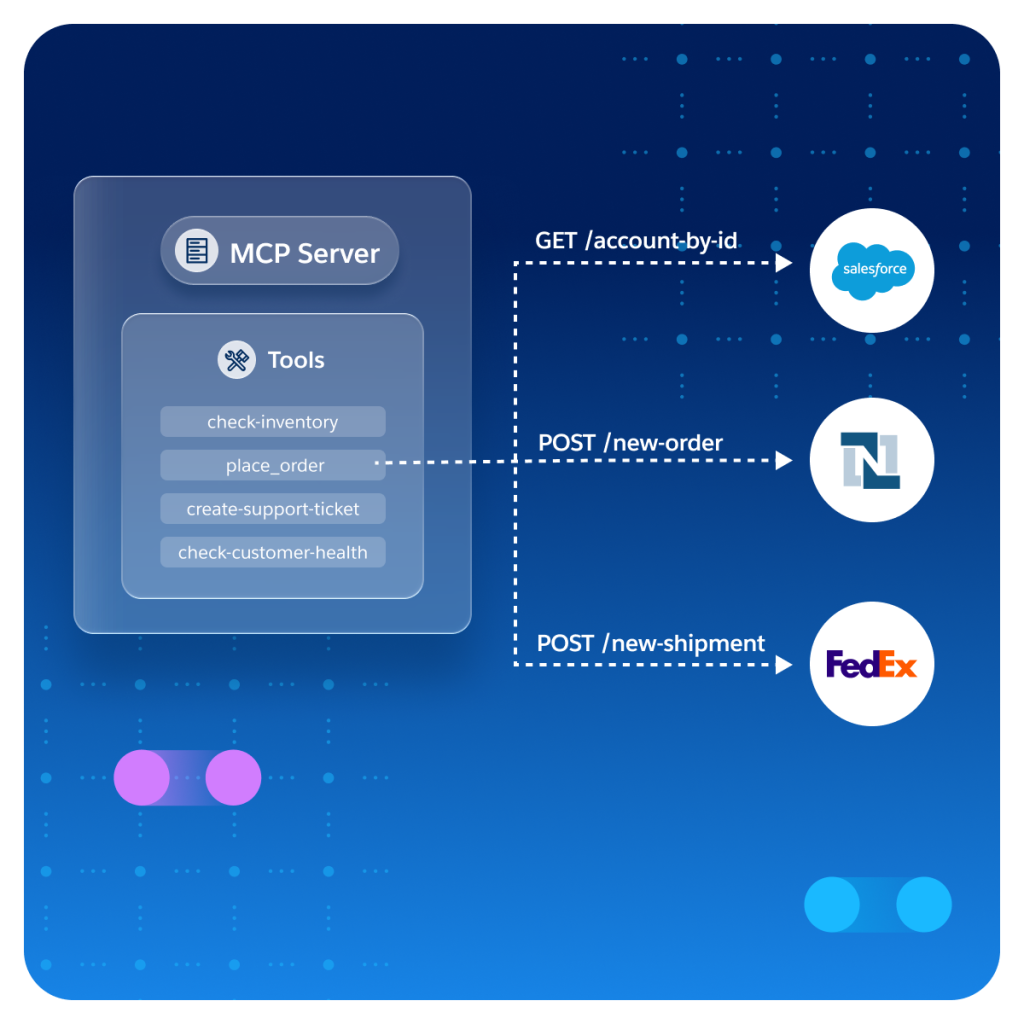
The most efficient path to be "agent-ready" is to treat MCP as an interface over your existing, stable REST APIs. You don't need to rewrite your backend logic. Instead, you expose existing capabilities with the semantic metadata agents need to understand when and how to use them.
Without a strategy, developers might deploy unmanaged MCP servers that bypass corporate security standards. Agent Fabric’s approach centralizes these servers into a managed registry. By requiring all MCP traffic to route through a secure gateway, IT maintains visibility into every tool an agent invokes, ensuring compliance and data protection.
By routing MCP traffic through a secure gateway, you can apply the same battle-tested policies (like OAuth, JWT validation, and rate limiting) that you use for standard APIs. Agent Fabric allows you to implement Attribute-Based Access Control (ABAC) to choose exactly which tools are available to specific agents based on their role and context.
No—it extends it. Your existing APIs are the engine. MCP is simply the "agent-friendly" interface layer that allows LLMs to interact with that engine. By using tools like MCP Bridge, you can turn existing APIs into MCP tools via gateway policy, preserving your current investments while making them AI-ready.
Yes. This is a core part of a mature strategy. A single agent can connect to multiple remote MCP servers simultaneously. For example, you can have an agent pull customer data from a CRM server while checking shipment status from a Logistics server through a single, secure AI gateway that provides a unified audit trail.
Try Agent Fabric free for 30 days. No credit card, no installations.
Tell us a bit more so the right person can reach out faster.
Learn more about pricing options and pick the right plan for your business.


